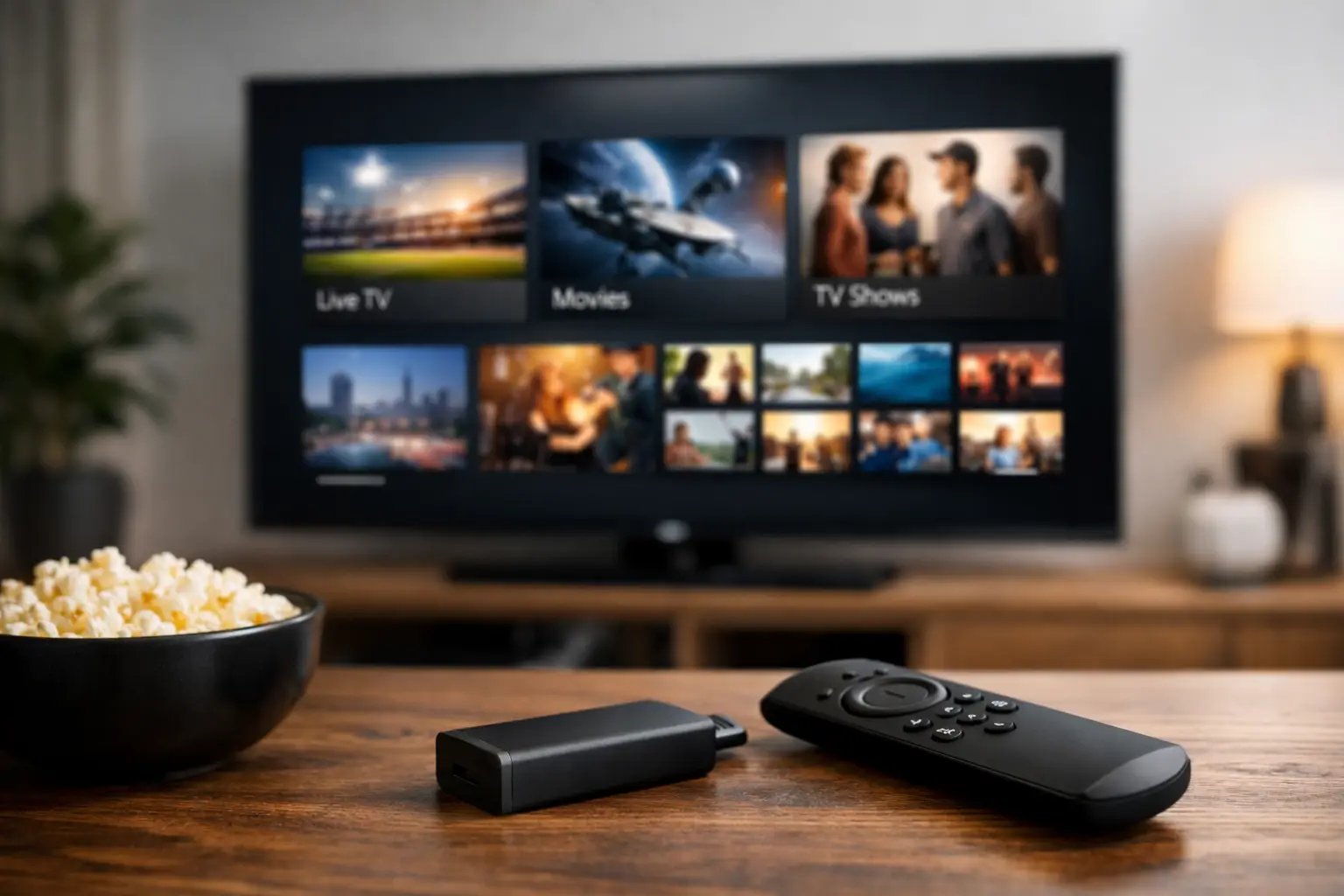
If your Firestick is loaded with five different apps just to cover sports, movies, local news, and international channels, the problem is not your device. It is the setup. The appeal of 4k iptv for firestick is simple – one interface, faster access, more live TV, deeper on-demand libraries, and a real shot at replacing subscription sprawl with a single streaming stack that actually feels complete.
Firestick remains one of the easiest ways to build a high-performance home streaming setup without spending much on hardware. It is compact, widely supported, and flexible enough for IPTV apps, media player apps, and premium 4K playback. But the device only performs as well as the service behind it. If the provider cannot maintain stable delivery, broad compatibility, and strong bitrate handling, the Firestick will expose every weakness fast.
Why 4K IPTV for Firestick makes sense
For most cord-cutters, Firestick hits the sweet spot between price and capability. You get a familiar interface, remote control convenience, solid app support, and enough power for live TV and on-demand playback. Pair that with a well-built IPTV service, and it becomes a full entertainment hub instead of just another app launcher.
The bigger advantage is consolidation. A strong 4K IPTV service for Firestick can combine live television, sports, regional content, premium movie channels, and on-demand libraries inside one ecosystem. That matters if you are tired of bouncing between platforms, remembering passwords, and paying for overlap across multiple subscriptions.
4K is the other major factor. Plenty of services advertise HD, but not all of them can consistently deliver high-bitrate 4K streams that look clean on larger TVs. On Firestick, especially newer models with better decoding support, good 4K sources can look excellent. The catch is that quality depends on the provider, your network speed, and the app you use to stream.
What separates average from premium 4K IPTV for Firestick
The first difference is channel and library depth. A basic IPTV package might give you enough live channels to get by. A premium setup pushes far beyond that, covering mainstream US channels, sports packages, international regions, kids content, specialty categories, and a large VOD catalog. If you also want movie nights, bingeable TV, documentaries, anime, and foreign titles in the same subscription, scale matters.
The second difference is infrastructure. This is where a lot of cheap services fall apart. They can look great on a sales page, then buffer during peak hours, fail during major games, or deliver inconsistent playback quality. Enterprise-grade infrastructure, better load distribution, and stable stream management make a visible difference on Firestick because the device is often used on living room TVs where buffering is harder to ignore.
The third difference is support. If setup breaks, playlists fail to load, or your app needs the right player configuration, you want a provider that responds quickly. Fast support through live chat or messaging platforms is not a bonus feature. For IPTV users, it is part of the product.
Firestick is easy. The service choice is the hard part.
A lot of people assume the device determines the experience. In reality, the service does most of the work. Firestick is just the delivery endpoint. If the IPTV platform offers stable streams, high-content volume, and app flexibility, setup is straightforward. If it does not, no amount of tweaking will turn it into a premium system.
That is why content volume and performance should be evaluated together. A provider offering 40,000+ live TV channels and 100,000+ on-demand titles sounds impressive, but those numbers only matter if navigation is usable and playback is consistent. The best services combine abundance with speed, uptime, and device compatibility.
For users who want more than live channels, bundled access can be a major advantage. A private media server layer adds another level of value, especially for households that want both live TV and deep catalog streaming in one place. That creates a more complete entertainment environment on Firestick, where live broadcasts and personal-library-style viewing can sit side by side.
What to look for before you buy
Start with stream stability. If you watch live sports, news, or event programming, buffering tolerance is basically zero. Look for providers that emphasize uptime, traffic handling, and responsive support. A free trial is useful here because no spec sheet tells you how a service performs on your network during real viewing hours.
Next, check 4K availability realistically. Some services label content as 4K, but the actual stream quality may be heavily compressed. If picture quality matters to you, especially on larger displays, ask whether the service includes true high-bitrate options or access to a dedicated media library with better 4K files. There is a big difference between a nominal 4K stream and a premium source that preserves detail.
Device support matters too. Firestick compatibility is the baseline, not the finish line. Many users also want access on Smart TVs, phones, tablets, desktops, and secondary streaming boxes. A provider that supports multi-device viewing gives your subscription more practical value across the household.
Finally, look at support hours and setup friction. The best IPTV experience is not just what happens when everything works. It is how quickly issues get resolved when something needs attention.
4K playback on Firestick depends on more than the app
It depends on your internet speed, your Wi-Fi quality, the Firestick model, and the stream source itself. If your provider has good infrastructure but your home network is weak, you may still see quality drops. If your network is solid but the stream is over-compressed, 4K will not look like real 4K.
For most households, stable broadband and strong Wi-Fi are enough for a very good experience. But if you are chasing top-end quality, especially for sports or large remux files, wired Ethernet adapters and stronger routers can help. Firestick can absolutely serve as a serious streaming device, but premium playback rewards a better home setup.
This is also where provider architecture matters. A service built for volume with low-latency delivery, fast panel response, and reliable channel switching will feel noticeably better than one that only wins on price.
Why bundled entertainment is gaining ground
Consumers are burned out on fragmented subscriptions. One app for live TV, another for premium series, another for sports, another for international channels – it adds up fast. IPTV on Firestick becomes far more compelling when it is paired with a large hosted media library.
That combination gives users live TV for everyday viewing and a deep on-demand catalog for everything else. Instead of stitching together a dozen monthly bills, you get a more centralized setup with better cost efficiency. For movie fans, sports viewers, expat households, and heavy streamers, that model simply matches real viewing behavior better.
This is where a provider like PrimeHub.Live fits naturally. The appeal is not just channel count. It is the combination of premium IPTV access, a private Jellyfin media server membership, broad device support, and enough content scale to replace a messy stack of disconnected services.
Is 4K IPTV for Firestick right for every user?
Not always. If you only watch a few mainstream apps and do not care about live TV, a simpler setup may be enough. If your internet is unreliable, premium stream quality may be hard to enjoy consistently. And if you never watch international channels, sports, or deep movie catalogs, the extra scale may go underused.
But for users who want broad access, flexible device support, strong 4K potential, and better value than stacking multiple platforms, Firestick is one of the most practical ways to run IPTV. It is affordable, familiar, and capable enough to power a serious living room setup when the service behind it is built properly.
The smartest move is to judge the experience where it matters – during real viewing, on your actual device, on your home network. A provider can promise abundance, 4K quality, zero buffering, and fast support. The good ones make those claims feel normal within the first hour of use.
If your goal is fewer apps, more content, and a faster path to live TV plus premium on-demand streaming, 4K IPTV on Firestick is not just a convenience upgrade. It is a better operating system for how people actually watch.
Leave a Reply