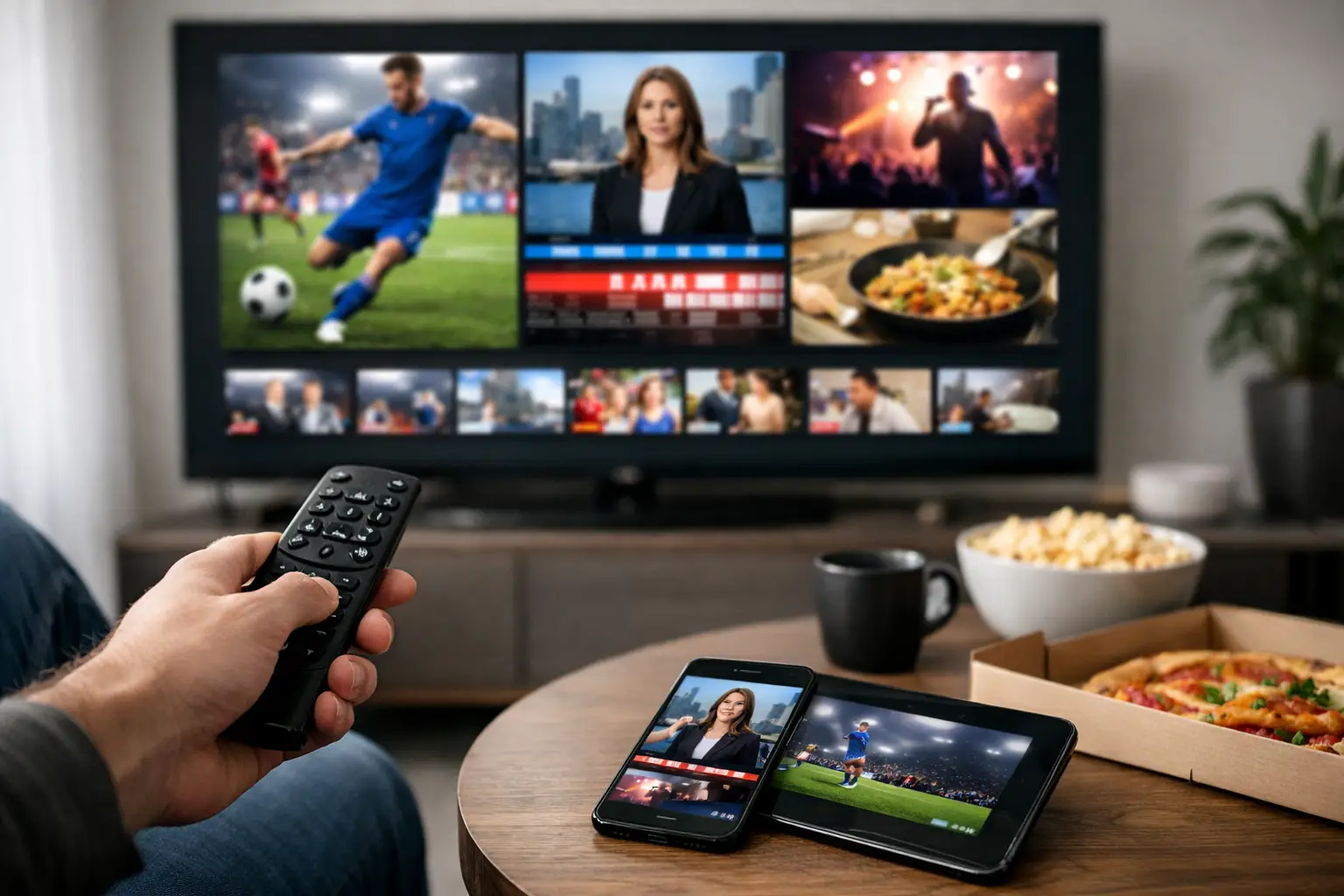
A streaming service with live channels should do more than replace a cable box. It should give you the game when it starts, the local or international programming your household actually watches, and a deep on-demand library when live TV is not enough. If your current setup means bouncing among apps, missing channels, and paying multiple monthly bills, the problem is not your screen. It is the fragmented subscription model.
For serious streamers, the better question is not simply, “Does it have live TV?” It is whether the service can handle the full entertainment workload: live sports, news, premium movies, international programming, kids’ content, replay access, and high-bitrate 4K viewing across the devices already in your home.
What a Streaming Service With Live Channels Should Include
Live channels are the foundation, but channel count alone does not define a quality experience. A strong Premium IPTV setup combines broad coverage with stable delivery, organized categories, and device flexibility. You want access that feels immediate, not a catalog that looks impressive until the stream fails at kickoff.
Start with the programming that has the least room for delay. Sports viewers need dependable live event access, high-quality PPV coverage, and replays when the schedule does not match real life. News watchers need major national, regional, and international feeds. Expat households often need channels from home without adding a separate app for every country or language.
Then consider everything around live television. A complete entertainment service should also cover movies, TV series, anime, documentaries, Bollywood, foreign-language titles, kids’ programming, and niche viewing that mainstream platforms frequently rotate out. This is where an extensive hosted media library earns its place. Live TV handles what is happening now. On-demand content handles everything else.
Stop Paying for a Stack of Half-Solutions
Subscription fatigue is not just about price. It is about friction. One service has a few shows you like. Another has a sports package. A third has international channels. A fourth is required for the movie library. Before long, your monthly entertainment cost climbs while your viewing experience gets worse.
A high-capacity streaming package consolidates that setup. Instead of managing multiple logins and separate billing cycles, you can use one provider for live TV and a personal-library-style media experience. The value is especially clear for households with different viewing habits. One person watches live soccer, another wants current TV series, someone else wants 4K films, and kids need their own reliable content options.
The right bundle does not force every viewer into the same narrow catalog. It gives the household range without making the remote feel like a project.
That does not mean every service is identical. Some platforms prioritize familiar domestic channels but offer limited international depth. Others have enormous on-demand catalogs but weak live coverage. Some work well on one device type and become frustrating on another. Compare the actual mix of live channels, video-on-demand depth, stream limits, playback quality, and supported devices before committing.
Performance Matters Most When Everyone Is Watching
No one cares about a huge channel list if the stream freezes during a championship match or a 4K movie constantly drops resolution. Performance is the product.
Look for a provider built around enterprise-grade infrastructure, fast delivery routes, and active support. Those details matter because live streams are more demanding than browsing a video catalog. Your connection, device, Wi-Fi strength, and the provider’s delivery network all affect the result. A capable service should be designed to minimize buffering and keep playback stable during high-demand events.
Your home setup also matters. A wired connection is usually the strongest choice for a main TV, particularly for high-bitrate 4K playback. If you rely on Wi-Fi, use a modern router and keep the streaming device close enough to maintain a strong signal. Fire Sticks, Android TV boxes, Smart TVs, phones, tablets, and desktop apps each have different processing limits, so a stream that looks perfect on one device may require a different setting on another.
This is why “4K available” is not the whole story. For viewers who care about image quality, ask whether the library includes high-bitrate 4K files, whether the device supports the format, and whether the home connection can sustain it. A 4K remux can look dramatically better than heavily compressed video, but it also asks more from your network and hardware.
Device Flexibility Is Part of the Value
A streaming service should fit into your existing home, not require you to rebuild it. Most households stream in more than one place: the living room TV, a bedroom screen, a tablet during travel, and a phone when there is no television nearby.
That makes broad compatibility a core requirement. Look for support across major Smart TV platforms, Fire Stick and Fire TV devices, Android TV, mobile devices, tablets, computers, and popular media players. The experience should remain consistent even when the screen changes. You should be able to pick up a series on a tablet, watch a live event on the big screen, and access your account without juggling separate services.
Simultaneous stream limits matter here. A single-stream plan may work for one viewer, but it becomes restrictive quickly in a family home. Multiple streams are more practical when live sports, kids’ programming, and on-demand viewing happen at the same time. Choose the tier based on real household behavior, not just the lowest monthly number.
Why Live TV and a Private Media Library Work Better Together
Live television is immediate. A private Jellyfin media server membership is personal, deep, and built for browsing beyond the current schedule. Together, they cover the two ways people actually watch.
With live TV, you can tune into a game, breaking news, a major event, or a channel you grew up watching. With a large hosted library, you can search for a specific film, start a complete series, explore anime, or pull up a documentary without waiting for a network schedule. The combination feels less like another app and more like your personal streaming universe.
Scale changes the experience. Access to 50,000+ live channels, 150,000+ video-on-demand titles, and a 5+ PB hosted media library creates more choice than a typical single-purpose streaming app. But quantity is only valuable when navigation is practical. Well-organized categories, search, favorites, and compatible playback apps help turn a massive library into something you can use every night.
Content availability can vary by region, device, and source, so it is smart to test the service with the channels and formats that matter most to you. For some viewers, sports and international programming are the deciding factors. For others, it is 4K movie quality or the breadth of TV series. A trial period is the fastest way to see whether the service works with your network, hardware, and viewing routine.
How to Evaluate a Streaming Service Before You Subscribe
Do not judge a service by a homepage claim alone. Use the trial period as a real performance check. Test it at the times you actually watch, preferably during a busy live event. Open several types of content: a live sports channel, an international channel, a standard movie, and a 4K title if that is part of your plan.
Pay attention to startup time, buffering, picture consistency, audio sync, guide organization, and how quickly support responds if you need setup help. Also test your primary device, not just your phone. A service can look great on a small screen while revealing limitations on a large 4K television.
Ask practical questions before selecting a tier. How many simultaneous streams are included? Which devices are supported? Is there around-the-clock help through live chat, Telegram, WhatsApp, or Discord? Can you move between live IPTV and the media library without maintaining separate accounts? Clear answers are a better signal than vague promises.
PrimeHub.Live is built for viewers who want that higher-capacity model: Premium IPTV, a massive hosted library, flexible device access, and support designed for people who expect their entertainment to work when they press play.
The best service is not necessarily the one with the loudest channel count. It is the one that makes your actual viewing easier: the match starts on time, the movie looks right on your TV, your family can watch without fighting over screens, and your entertainment stops being a pile of disconnected subscriptions. Start with a 24-hour trial, test it under real conditions, and choose the setup that earns a permanent place on your home screen.
Leave a Reply